
A child can draw a stick figure.
Two arms. Two legs. A head. A body.
Now draw another one exactly like it, except this one has red shoes.
If your goal is simply to count people, both drawings are equally useful. Either one can represent a person in a database. The informational resolution is sufficient for the task.
But imagine a factory now needs to manufacture hats that match the color of the shoes.
Suddenly, one of those stick figures becomes dramatically more valuable than the other.
The difference is not artistic quality. The difference is informational depth. One drawing contains an additional dimension of reality that enables a decision the other cannot support.
That, in many ways, is the essence of a digital twin.
A digital twin is not merely a digital file, a map, a spreadsheet, or a collection of measurements. A true digital twin is a connected digital representation of a physical object and the processes acting upon it over time. It is the difference between storing information and modeling reality.
And nowhere is that distinction more important than in agriculture.
For decades, agriculture has operated through fragmented observations. A soil sample here. An image there. A scouting note scribbled on paper. A yield map generated months later. Valuable information, certainly, but disconnected information. Static snapshots of a living, dynamic system.
A true digital twin changes the nature of the system itself.
Consider the difference between an old pedometer and an Apple Watch.
A pedometer counts steps. That is essentially all it does. It gives you a number.
An Apple Watch, however, continuously captures a web of connected information: heart rate during each step, pace changes during elevation shifts, breathing patterns, recovery behavior, environmental temperature, location, slope, time, variability, exertion, and movement history. More importantly, all of those measurements exist together within a synchronized digital framework.
Now entirely new forms of analysis become possible. Baselines emerge. Anomalies can be detected. Fatigue can be modeled. Performance can be benchmarked. Health trajectories can be predicted.
The power does not come from more data alone. It comes from connected dimensions of reality existing together in a digital system.
A pedometer records an event. A digital twin models a process.
The same distinction exists in industrial systems.
Imagine a jet engine represented only as a digital inventory database. Every component has a serial number. Every set screw has a supplier. Every fan blade has a part number and manufacturing date. That system is useful for logistics and maintenance.
But now imagine a second representation of that same engine, one containing the thermal properties of the metals, airflow dynamics through the cavities, stress tolerances during acceleration, expansion coefficients under heat, vibration signatures, and fatigue behavior over time.
Now engineers can simulate reality before reality happens. They can test a new alloy on a turbine blade digitally before manufacturing it physically. They can model failure risk, predict maintenance intervals, and optimize efficiency.
The first system tracks parts. The second system understands behavior.
That is the leap from digital inventory to digital twin.
Agriculture, however, is an even more difficult problem than an engine.
A field is not static. A soil profile is not uniform. A crop is not a machine assembled identically each time. Every acre contains countless interacting variables: soil texture and density, layering, pH, salinity, water movement, nutrient dynamics, rooting depth, management history, weather variability, genetics, disease pressure, and irrigation quality, and more all interacting simultaneously across time and space.
And yet much of agriculture still attempts to manage this complexity using disconnected measurements.
This is precisely why agriculture needs digital twins.
At LandScan, our work is based on the idea that soil and crop assessment and management require a digital representation of both the crop system and the soil system and, critically, the relationships between them.
The Digital Vegetation Signature (DVS), system digitizes the crop canopy using fused sensing approaches that combine multispectral imagery and photogrammetry to produce three dimensional geometry, spatial relationships, structural patterns, and reflectance characteristics. The result is not simply a picture of a field. It is a multidimensional digital representation of the vegetation itself.
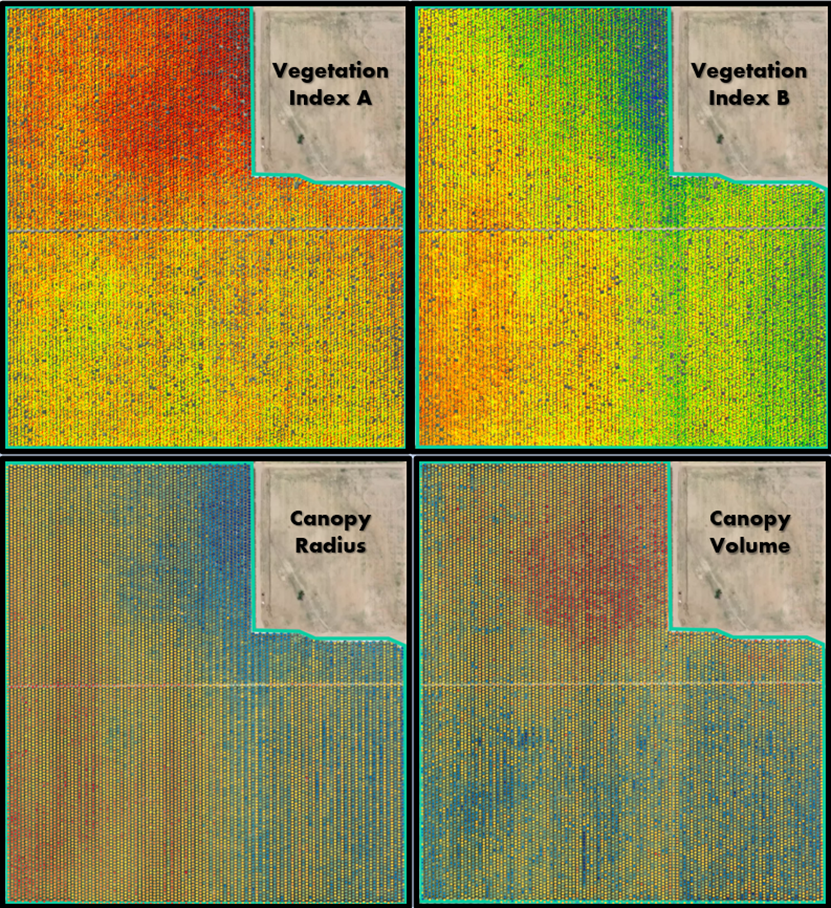
Figure 1: The DVS produces dozens of independent signatures of the crop canopy each with a unique pattern. This pattern contains information useful for analyzing the crop performance and tracking changes over time and management.
Many of those dimensions are things humans cannot easily define.
Facial recognition software offers a useful analogy. Humans may consciously recognize twenty or thirty facial features, eye color, nose shape, jaw structure, and mouth width. But advanced recognition systems may evaluate hundreds of measurable relationships and signatures, many of which humans perceive subconsciously without having language for them.
Those hidden dimensions are what make the system powerful.
Agriculture is similar. There are canopy signatures, spatial structures, reflectance relationships, and geometric patterns that humans can observe but not formally quantify. Yet those hidden signatures still contain information. And information, when connected correctly, creates analytical power.
Below ground, the Digital Soil Core (DSC), system performs a similar transformation for the soil profile itself.
Rather than treating soil as isolated and discrete chemistry or physical property measurements, the DSC digitizes the profile using ultra high resolution imagery, spectroscopy, acoustics, structural characterization, depth resolved sensing, and layer sequencing. The goal is not simply to measure soil properties individually, but to capture the signature of the soil profile as an interconnected system.
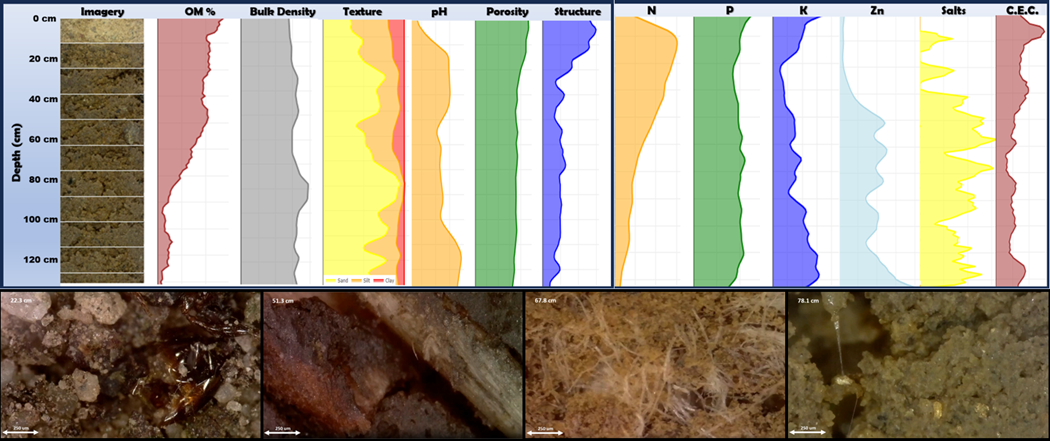
Figure 2: The DSC has seven sensors that produce a digital signature of the soil profile in 60 seconds. The DSC is moved from one location to another around a field to create a digital representation of the soil profile in 3D.
That distinction matters enormously.
Two soils may have similar chemistry and yet perform completely differently because their profile architecture differs. One may contain a restrictive layer that limits rooting depth. Another may have transition zone altering water movement. A third may contain salinity accumulation or pH variation at a critical depth interval affecting nutrient uptake.
The chemistry alone may not explain the outcome.
The soil architecture matters. The relationships matter.
This is where the concept of a digital twin becomes transformational for agriculture.
Consider five distinct vegetation performance classes identified within an orchard using DVS canopy signatures. Those canopy signatures are then connected to DSC measurements collected beneath representative trees within each class. Now, for the first time, the system begins linking crop performance and genetics to the reality beneath it: rooting environment, water and nutrient dynamics, soil architecture, and management history.
The soil and crop are no longer independent observations.
They become connected digital systems.
That connection enables an entirely new category of analysis: root cause analytics.
Now the question is no longer simply, “What happened?”
The question becomes:
Why did it happen? What is consistently different beneath the lowest performing trees? Is the limiting factor physical, chemical, hydrological, biological, or economic? Can it be corrected? Should it be corrected? Would remediation create a return on investment?
This begins to resemble the famous barrel analogy from Liebig’s Law of the Minimum, where the shortest stave determines how much water the barrel can hold. Crop yield behaves similarly. The greatest limitation often determines the ultimate performance ceiling.

Figure 3: The RCA integrates the digital crop and soil signatures to enable a yield limiting factor analysis to manage crop performance and track changes over time. It enables the manager to dynamically adjust scenarios based on economics.
But identifying that limiting factor inside a massively complex biological system has historically been extraordinarily difficult.
Digital twins change that.
Once the soil system, crop system, environmental system, and management system become digitally connected, dynamic decision support becomes possible. LandScan’s Root Cause Analytics (RC), platform integrates digital soil and crop information, irrigation and fertility economics, water quality, fertilizer characteristics, amendment properties, operational constraints, and expected economic outcomes into a unified analytical environment.
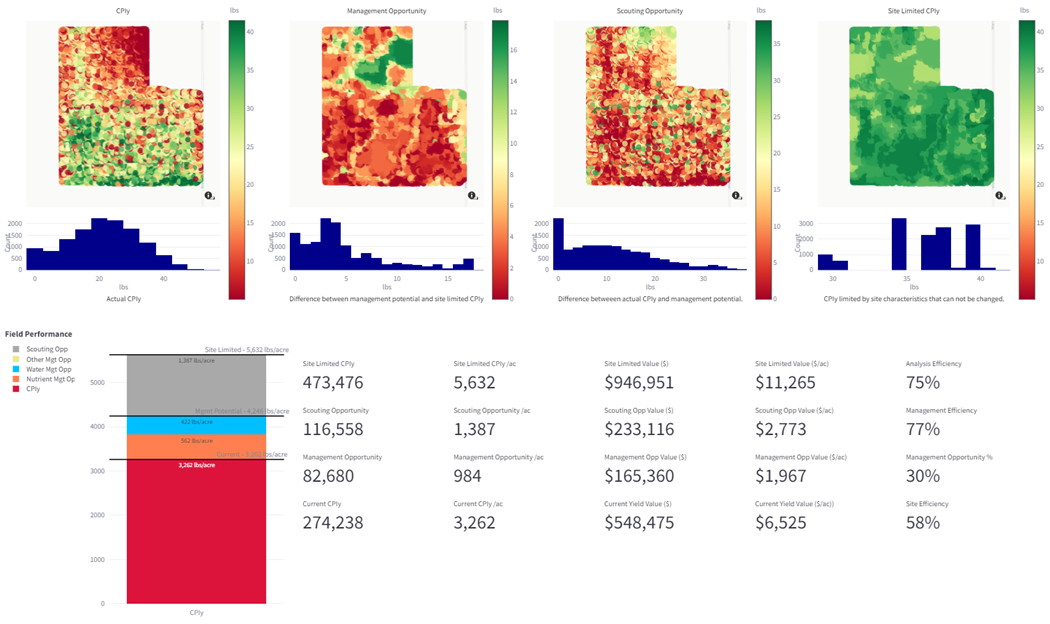
Figure 4: The RCA interactive software allows the manager to view, explore, and dynamically create and analyze scenarios.
Now the manager is no longer reacting to isolated measurements.
The manager can simulate outcomes. Evaluate tradeoffs. Identify limiting factors. Benchmark performance. Prioritize interventions. Optimize economics alongside agronomics.
The system moves from observation to understanding.
And that may ultimately be the most important idea behind digital twins.
The future of agriculture is not simply about collecting more data. Agriculture already contains oceans of disconnected data. The future belongs to systems capable of creating faithful digital representations of reality, systems that can digitize the soil, digitize the crop, connect those systems together, and continuously learn and improve from their interactions over time.
Because once agriculture becomes truly digitized, entirely new forms of intelligence become possible.
And that is what a digital twin really is.
