
Why Agriculture Needs Digitization Through Digital Twins
The chart tells a simple story: capital is following AI, but AI does not flow evenly into every industry. It flows into industries that have already become digital.
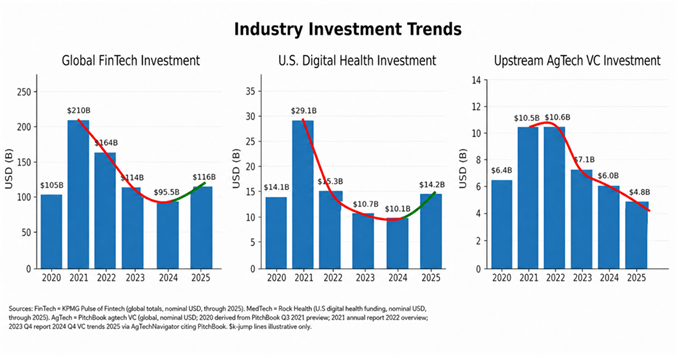
Figure 1. Investment trends show AI-era capital flowing back into more digitized sectors while upstream AgTech continues to lag
FinTech was born digital. Money, transactions, risk scores, credit histories, payments, fraud signals, and customer behavior already exist as structured data. When AI arrived, FinTech did not have to first convert the physical world into usable information. The data layer was already there. AI had something to work with.
MedTech is different, but it reached a similar place. Healthcare has been forced to digitize through regulation, privacy requirements, electronic medical records, imaging systems, diagnostics, reimbursement rules, and clinical evidence standards. It is not perfect, but much of the medical system has become machine-readable. AI can now interpret scans, assist with diagnosis, accelerate drug discovery, and support clinical workflows because the underlying data infrastructure exists.
AgTech has not made that transition.
Agriculture has digitized the surface of the industry, but not the biological system itself. We have satellite images, drone maps, soil samples, yield monitors, equipment data, and farm management platforms. But much of the data is still sparse, subjective, shallow, inconsistent, or disconnected from the root causes of crop performance. A soil test, a vegetation index, or a yield map at harvest may describe symptoms, but they rarely explain the system.
That is the core reason AgTech investment has struggled while FinTech and MedTech are benefiting from the AI wave. It is not because agriculture is less important. It is because agriculture has not yet created the digital foundation that AI requires.
The world’s leading technology and industrial companies are now making this point directly. Jensen Huang, founder and CEO of NVIDIA, said, “NVIDIA’s Omniverse digital twin operating system and Cosmos physical AI serve as the foundational libraries for digitalizing the world’s physical industries.” Siemens, writing about Roland Busch’s CES 2026 keynote, framed the industrial shift even more bluntly: “Whether it’s an AI factory, a chip plant or a car factory, operating without a digital twin is no longer imaginable.”
That is the message agriculture cannot ignore: AI does not become truly powerful in physical industries until the physical world has first been digitized into a trusted, dynamic model.
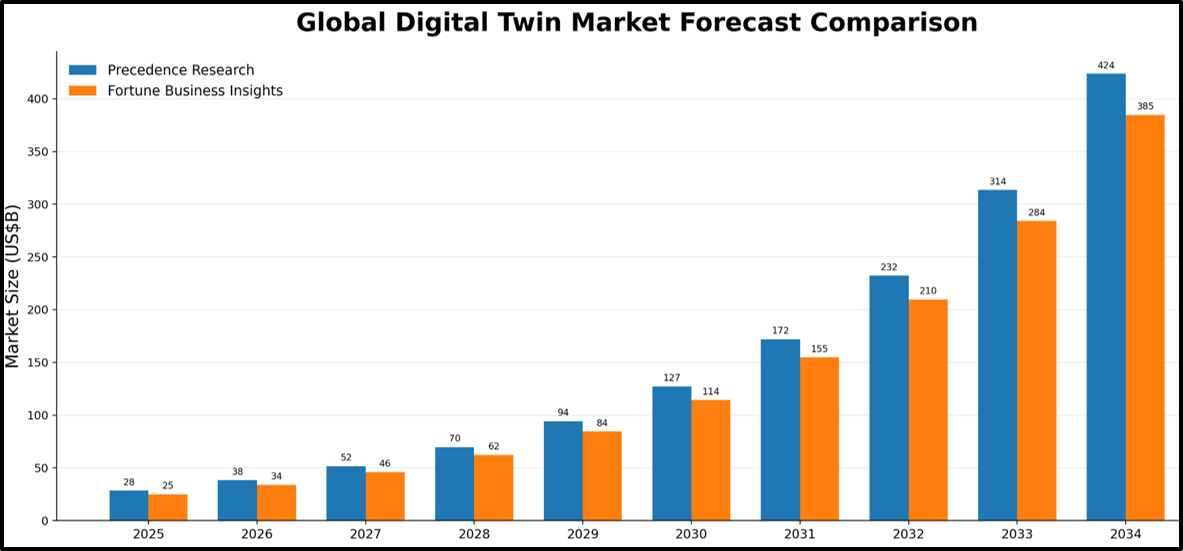
Figure 2. Global digital twin forecasts show digital twins becoming a large industrial infrastructure category.
Agriculture is one of the largest physical industries on Earth, but it is also one of the least digitized at the level that matters most: the soil, crop, water, nutrient, genetic, and management system that actually determines production.
AI cannot optimize what it cannot see. It cannot reliably recommend water, nutrients, amendments, genetics, or management practices if the underlying soil and crop system is represented by low-resolution averages, incomplete observations, and disconnected layers. Agriculture is spatial, biological, physical, chemical, and temporal. Every acre is different. Every crop response is shaped by the interaction of genetics, environment, and management.
That is where digital twins become essential.
A true agricultural digital twin is not just a map. It is a high-resolution, spatially explicit model of the field as a functioning production system. It connects soil properties, vegetation response, management history, and yield potential into one coherent digital representation. Instead of asking, “What does this image show?” or “What did this soil sample say?” the digital twin asks, “What is limiting production here, why is it happening, and what is the best economic action?”
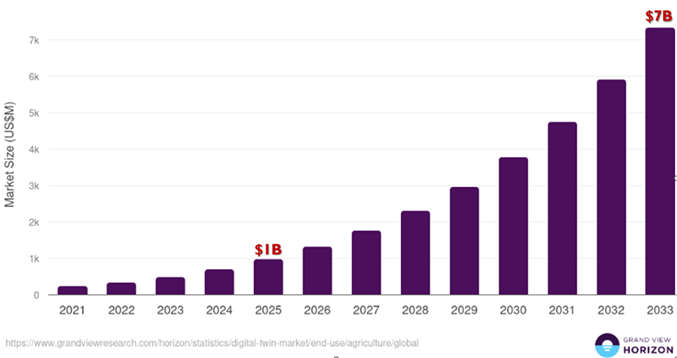
Figure 3. Agriculture digital twin market estimates point to rapid growth as simulation, prediction, and decision support become more important to farm management, optimization, and sustainability
The broader agriculture industry is beginning to say the same thing. Kubota says its digital twin “recreates fields in a virtual space, simulates growth and disease occurrence using various sensing data, and provides recommendations for harvest timing and farming operations based on predictive results.” AGCO has disclosed work on both a physical smart farm and a “digital twin farm” to enable virtual simulations. Bayer says its breeders now use “machine learning and digital twin technology” to anticipate plant performance across “thousands of micro-level climatic and soil conditions.”
But the most important signal may be coming from John Deere.
Deere is not simply saying digital twins are useful. Deere describes the John Deere Operations Center as “the digital twin of a farm.” Deere has also said, “our future guidance solutions will be enabled by the digital twin of the farm” in our Operations Center. And at Deere’s NYSE Investor Day, Jahmy Hindman described “creating that digital twin of your farm” as what unlocks the farmer’s ability to move “up the tech stack” while lowering inputs, lowering labor, and increasing yields.
That raises an unavoidable strategic question: if digital twins are becoming the operating layer for agriculture, who will control the intellectual property that defines how those twins are built, updated, validated, and used to make decisions? In every major technology transition, the companies that control the foundational IP do not just participate in the market — they help shape the architecture of the market. Digital twins will be no different. Dennemeyer, a global intellectual property management firm that advises companies on patent strategy, wrote in its 2025 analysis of digital twin patent protection that “Patent protection will be essential to safeguarding investment in this innovation and ensuring competitive advantage…” In agriculture, the leaders will not simply be the companies with the most data or the largest equipment footprint. They will be the companies that control the patent-protected methods for converting real fields, soils, crops, and management systems into trusted digital decision engines.
That matters because Deere’s language connects digital twins directly to the future of autonomy, guidance, input optimization, labor reduction, and yield improvement. In other words, Deere is not treating the digital twin as a dashboard. Deere is treating it as infrastructure.
That is the strategic point for agriculture: the winning platform will not be the company with the most disconnected data layers. It will be the company that can create the most trusted digital representation of the farm as a biological production system. The digital twin becomes the bridge between field reality and AI decision-making.
With digital twins, agriculture can move from observation to simulation. From generic recommendations to site-specific prescriptions. From treating fields as uniform averages to managing them as complex biological systems. From reactive decision-making to predictive and preventive management. This is what allows AI to become more than a chatbot or dashboard in agriculture. It becomes a decision engine grounded in the physical reality of the field.
The next generation of AgTech will not be won by companies that simply collect more data. It will be won by companies that create the best digital representation of the soil and crop system. That digital foundation is what enables trusted analytics, better prescriptions, input optimization, yield prediction, sustainability measurement, and eventually autonomous management.
The chart shows the warning sign. Investment is moving toward industries ready for AI. FinTech is ready. MedTech is increasingly ready. AgTech is not yet ready because the industry has digitized around the farm, but not deeply enough within the farm.
But the market is now telling us where it is going. NVIDIA is saying physical industries need digital twins. Siemens is saying modern industrial operations are becoming unimaginable without them. Kubota, AGCO, Bayer, and Deere are all pointing toward digital twins as the basis for simulation, prediction, guidance, and decision support in agriculture.
For agriculture to participate in the AI future, it must first become truly digital. And the most direct path to that future is the creation of high-resolution digital twins of the soil and cropping system.
That is where the next AgTech platform will be built.
